Number One South End
Number One South End is a building that was formerly owned by BGS, and used by the school for a variety of purposes over much of the 19th and 20th Centuries. It is located at the west end of the school, next to the gated entrance to the Mart Yard, and remains there to this day.
19th Century
In 1827 the house was built as the official headmaster's residence for Dr Thomas Homer who had recently arrived. The original front wall of the Mart Yard was demolished to make way for it:
"...at that time a house was erected upon part of the playground in South End at an expense of £2,007-0s-11d, which was borne out of the Charity fund".
Records exist of the exterior of the house being painted in 1841, and it was used periodically to accommodate boarders until the early 20th Century.
Occupants in 1841
According to the 1841 census
To be completed
Occupants in 1851
According to the 1851 census
| Name | Relation to Head | Condition | Age | Occupation | Where Born |
|---|---|---|---|---|---|
| George Edwin Pattenden | Head | Married | 27 | Headmaster of Grammar School, MA, Clergyman not having <illegible> | Warbleton, Sussex |
| Matilda Pattenden | Wife | Married | 25 | Brixton, Surrey | |
| Florence Pattenden | Daughter | 2 | Sleaford, Lincoln | ||
| Gertrude Pattenden | Daughter | 1 | Humberston, Lincoln | ||
| Clara Pattenden | Daughter | Under 1 month | Boston, Lincoln | ||
| George Thos Peele | Pupil | Unmarried | 14 | Scholar | Long Sutton, Lincoln |
| Robert Millington | Pupil | 10 | Scholar | Gedney, Lincoln | |
| Francis Vise | Pupil | 12 | Scholar | Holbeach, Lincoln | |
| Miller Howard | Pupil | Unmarried | 16 | Scholar | Long Sutton, Lincoln |
| Sarah Handley | Servant | Unmarried | 23 | General Servant | Reddington, Notts |
| Sabina Bartley | Servant | Unmarried | 19 | General Servant | Tetney, Lincoln |
| Harriet Wilkinson | Servant | Unmarried | 11 | General Servant | Humberston, Lincoln |
| Alice Riggalls | Nurse | Married | 52 | Monthly Nurse | Sleaford, Lincoln |
Occupants in 1861
According to the 1861 census
| Name | Relation to Head | Condition | Age | Occupation | Where Born |
|---|---|---|---|---|---|
| George E Pattenden | Head | Married | 37 | BD Headmaster of Grammar School, and incumbent Chapel of Ease | Warbleton, Sussex |
| Matilda A Pattenden | Wife | Married | 36 | Brixton, Surrey | |
| Florence Pattenden | Daughter | Unmarried | 12 | Scholar | Sleaford, Lincoln |
| Gertrude Pattenden | Daughter | Unmarried | 11 | Scholar | Humberston, Lincoln |
| Clara L Pattenden | Daughter | Unmarried | 10 | Scholar | Boston, Lincoln |
| Ada M Pattenden | Daughter | Unmarried | 8 | Scholar | Boston, Lincoln |
| Rosalie E Pattenden | Daughter | Unmarried | 7 | Scholar | Boston, Lincoln |
| Charles R Pattenden | Son | Unmarried | 6 | Scholar | Boston, Lincoln |
| Edith A Pattenden | Daughter | Unmarried | 4 | Boston, Lincoln | |
| Frederick Pattenden | Son | Unmarried | 3 | Boston, Lincoln | |
| Beatrice Pattenden | Daughter | Unmarried | 10 months | Boston, Lincoln | |
| Ann Rook | Servant | Unmarried | 38 | Cook | Swineshead, Lincoln |
| Sabina Bratley | Servant | Unmarried | 29 | Housemaid | Tetney, Lincoln |
| Maria Bratley | Servant | Unmarried | 25 | Housemaid | Tetney, Lincoln |
| Mary Green | Servant | Unmarried | 29 | Housemaid | Boston, Lincoln |
| Lucy J Read | Servant | Unmarried | 19 | Nursemaid | Skirbeck, Lincoln |
| Emma Brackenbury | Servant | Unmarried | 20 | Kitchenmaid | Hundleby, Lincoln |
| Mary A Haynes | Servant | Unmarried | 13 | Kitchenmaid | Boston, Lincoln |
| Joseph C Dunn | Pupil | Unmarried | 21 | Scholar | Wales |
| James Nell | Pupil | Unmarried | 14 | Scholar | Louth, Lincoln |
| Francis Vise | Pupil | 12 | Scholar | Holbeach, Lincoln | |
| Thomas Kemp | Pupil | Unmarried | 11 | Scholar | Thimbleby, Lincoln |
Occupants in 1871
According to the 1871 census
| Name | Relation to Head | Condition | Age | Occupation | Where Born |
|---|---|---|---|---|---|
| George E Pattenden | Head | Married | 47 | BD Headmaster of Grammar School, and incumbent Chapel of Ease | Warbleton, Sussex |
| Sarah Pattenden | Mother | Widowed | 70 | Hackney, Middlesex | |
| Florence Pattenden | Daughter | Unmarried | 12 | Scholar | Sleaford, Lincoln |
| Clara L Pattenden | Daughter | Unmarried | 20 | Boston, Lincoln | |
| Ada M Pattenden | Daughter | Unmarried | 18 | "a a of oxford" | Boston, Lincoln |
| Rosalie E Pattenden | Daughter | Unmarried | 17 | Artificated Student of Cambridge | Boston, Lincoln |
| Charles R E Pattenden | Son | Unmarried | 16 | Scholar | Boston, Lincoln |
| Frederick W Pattenden | Son | Unmarried | 13 | Scholar | Boston, Lincoln |
| Beatrice M Pattenden | Daughter | Unmarried | 10 | Boston, Lincoln | |
| Richard Hamer | Fourth Master | Illegible | 25 | BA Fourth Master of Grammar School | Beguildy, Wales |
| Tilden Smith | Nephew | 18 | Scholar | Camberwell, Surrey | |
| George A Smith | Nephew | 12 | Scholar | Camberwell, Surrey | |
| Arthur A Smith | Nephew | 11 | Scholar | Camberwell, Surrey | |
| Henry T Bensted | Pupil | 14 | Scholar | Tonge, Kent | |
| James C Bensted | Pupil | 13 | Scholar | Tonge, Kent | |
| William C Olpherts | Pupil | Unmarried | Scholar | ||
| Henry A Peake | Pupil | Unmarried | Scholar | ||
| Charles E Peake | Pupil | Unmarried | Scholar | ||
| William L Hunt | Pupil | Unmarried | Scholar | ||
| John H Leachman | Pupil | Unmarried | Scholar | ||
| Edwin Welsh | Pupil | Unmarried | Scholar | ||
| Reginald M Harrison | Pupil | Unmarried | Scholar | ||
| Jessie Pickworth | Pupil | Unmarried | Scholar | ||
| William H Baxter | Pupil | Unmarried | Scholar | ||
| Edward T Black | Pupil | Unmarried | Scholar | ||
| Arthur S Black | Pupil | Unmarried | Scholar | ||
| William H Smith | Pupil | Unmarried | Scholar | ||
| Thomas B C Wren | Pupil | Unmarried | Scholar | ||
| John F Cartwright | Pupil | Unmarried | Scholar | ||
| George L Grant | Pupil | Unmarried | Scholar | ||
| Samuel M Grant | Pupil | Unmarried | Scholar | ||
| Frederick M Chapman | Pupil | Unmarried | Scholar | ||
| Charles H Fowler | Pupil | Unmarried | Scholar | ||
| Thomas Cammack | Pupil | Unmarried | Scholar | ||
| Betsey Sutton | Servant | Unmarried | |||
| Betsey Ann Rylatt | Servant | Unmarried | |||
| Alice A Pocklington | Servant | Unmarried | |||
| Emma Harness | Servant | Unmarried | |||
| Isaac Overton | Servant | Unmarried |
Occupants in 1881
According to the 1881 census
To be completed
Occupants in 1891
According to the 1891 census
To be completed
1950s
In 1953 a new headmaster's residence, called Ormiston House, was built on Rowley Road shortly before the arrival in 1954 of William John Ricketts. At that point it was therefore possible to bring the ground floor of Number One South End into use as temporary classrooms. They were used by the mathematics and science sets of the sixth form, the original kitchen becoming a biology laboratory.
1960s and 1970s
The house came into use as flats for several teachers, including at various times Stan Cawthorne, James Loader, Conor McGaughey, Ted Seppings and Ron Abbott.
James Loader's description of the house is quoted below:
"South End was, potentially, a beautiful house. The governors charged virtually nothing for rent and the flats were huge. I think we took the place very much for granted. I was very lazy about upkeep and never looked after the garden or the yard; as a result there were cabbages growing between the flagstones. The most energetic thing I ever did out there was sun-bathe.
People used to say the place was haunted. The cellar was certainly very creepy; there were the remains of an old kitchen range in there, and I think a place where there had been a well. Also horrible hooks in the ceiling, where they used to hang meat."
During the 1970s, the school Tuck Shop was formed, and operated during breaktimes out of a ground floor room of the building.

1980s - Sixth Form house
The flats became vacant towards the end of the 1970s. The LEA were financially assisted by the foundation governors to adapt the ground floor of the premises as a Sixth Form block. Three tutorial classrooms, a social room, kitchen and bathroom were provided for the use of the Upper Sixth.
If Doctor Pattenden Could see us now!

(extracts from an article by David J McGladdery from The Bostonian - 1980)
At long last the upper-sixth formers of Boston Grammar School have been afforded the comforts and privileges long since promised them. This has been made possible by the renovating and converting of the ground-floor of the former school flats into three tutorial rooms and one common room. To those of you who are not familiar with the building I am alluding to, it is the rather grand ivy-ccovered house facing the river, next to the main gates of the school in South End.
It was built as the official headmaster's residence in 1827, for Dr Thomas Homer. However, he could not have lived in it for very long, as the school roll at that time was reputed to have dwindled to "no boys at all". This also helps to establish why Dr Homer was also vicar of Freiston. Occupation of this building was taken by Dr George Edwin Pattenden in 1850. During his reign, number one South End was extended in 1871 to accommodate boarders. The names which can be seen incised in to the brickwork over the door to number 1a South End bear testimony to the original use of this wing.
By this time, the school roll had risen dramatically to one hundred and thirty-six, with four additional masters. The renewed academic progress of the school under Dr Pattenden is reflected in a report made in 1871 by T.H. Ward, a fellow of Brasenose College, Oxford the French "excellent; much better than amongst boys of the great public schools."
It appears that the buildings in South End have been used intermittently for most of this century. And part of the upper floor was once used, temporarily, as a laboratory. It was not until the late fifties that the headmaster - then Mr W.J. Ricketts - vacated South End for a new residence in Rowley Road. The empty house was subsequently divided up into flats for occupation by members of the teaching staff.
As adequate space in the main school was totally lacking for a modern sixth form, the Foudation Governors financially assisted the local authority in enabling the ground floor of number one South End to be adapted as a sixth form social block. The premises themselves are carpeted throughout and comprise three rooms for teaching, a social room complete with gas fire, easy chairs and coffee tables; a kitchen where hot drinks can be prepared; and even a bathroom. And there can't be many sixth formers in the country who enter every morning through a ten-foot tall front door, flanked by two ionic columns, and who can boast of a form-room possessing a marble fireplace!

Kevin J Ashton, Christopher P Bohn
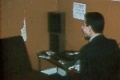
Mark Isaac and record player (not to be used during lesson time)


The Reality of Number One South End
The sixth formers have now long gone from Number One South End, resident in a new building designed for the purpose. Was it really as David McGladdery described in 1980? The building is certainly impressive, but the furnishings did not match up to the grandeur; not that you would expect or even want them to in a sixth-form den.
The usual tales of strange exploits could be told: of an illicit smokers' corner, of junior members of the school being locked in the cellar, of a moped in the bath, but I will choose to tell another story of the "Sixth-Form House".
The Play Reading
There was to be a series of play readings for sixth formers studying 'A' Level French, held jointly between the (boys) Grammar School and the (girls) High School. The first such reading took place at the High School.
The boys were welcomed at the High School into the spotless common room with library-style seating and were served tea, coffee and the usual assortment of nibbles. It was a pleasant evening, but quite a culture shock was to come for the girls.
The venue for the return match was the common room in Number One South End. Seating consisted of a huge, rather moth-eaten three piece suite and a selection of other, unmatched chairs. Apart from tea and coffee, cider was also available. Compared to the sterile atmosphere of the High School common room, this was like some illicit drinking den. An even greater surprise was the food: Steve "Chippy" Neal went out to his father's fish shop and returned with a cardboard box full of steaming cod and chips.
So was Number One South Street luxurious? Emphatically, not! Was it comfortable and conducive to creative thought? You bet!
Sale and present day
Number One South End was sold in the late 1980s (believed to be circa 1988) and ceased to be used by the school. The Sixth Form were housed entirely in the Junior Common Room from that point until a new Sixth Form Block was completed in 1993. The building was subsequently split into separate private flats, and is now known as 'Principal House'.
